Do Nicotine Patches Help Quit Vaping? What the Science Actually Says
Roon Team
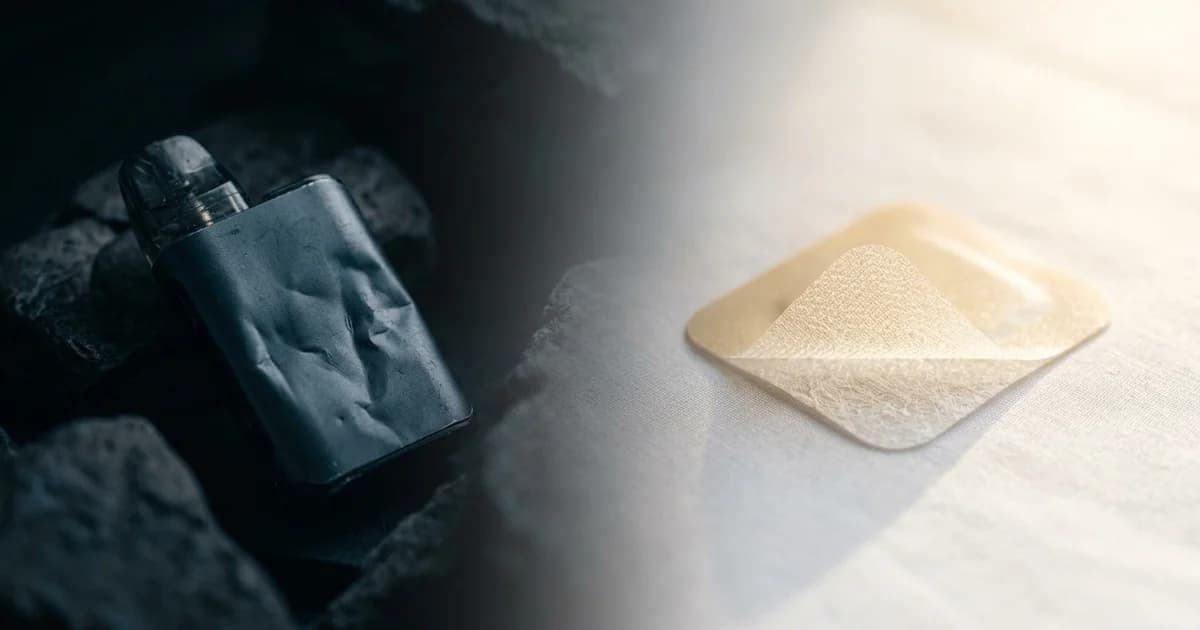
Do Nicotine Patches Help Quit Vaping? What the Science Actually Says
You slapped on a nicotine patch, waited for the cravings to stop, and then found yourself holding a vape again by lunch. Sound familiar? The question "do nicotine patches help quit vaping" is one that millions of people are Googling right now, and the answer is more complicated than the box at your local pharmacy suggests.
Nicotine patches were designed in the late 1980s for cigarette smokers. They deliver a slow, steady drip of nicotine through the skin over 16 to 24 hours. The problem? Vaping is not cigarettes. And treating it like the same addiction ignores some critical differences in how nicotine gets delivered, how habits form, and what your brain actually craves when you reach for that device.
Key Takeaways:
- Nicotine patches were designed for cigarette smokers, and limited clinical data exists for their effectiveness in vaping cessation specifically.
- Patches address the chemical side of nicotine dependence but ignore the behavioral and sensory components that make vaping so hard to quit.
- Combining NRT with behavioral support produces better outcomes than patches alone.
- Replacing the physical ritual (not just the nicotine) may be the missing piece for most vapers trying to quit.
What Nicotine Patches Actually Do
A nicotine patch is a form of nicotine replacement therapy (NRT). You stick it on your skin, and it releases nicotine into your bloodstream at a controlled rate. The idea is simple: give your body the nicotine it's dependent on while removing the harmful delivery method (smoke or vapor).
According to Informed Health, NRT helps roughly 17 out of 100 people quit smoking, compared to about 11 out of 100 who quit without it. That's a meaningful bump, but it also means the majority of people using patches still don't quit.
A meta-analysis on PubMed found that across 17 studies involving over 5,000 patients, abstinence rates for the active nicotine patch were 27% at the end of treatment and 22% at six months. Those numbers drop further over time. A 10-year follow-up study published in ScienceDirect found continuous abstinence rates of just 7.9% for the active patch group versus 2.6% for placebo after a decade.
These numbers, though, come almost entirely from studies on cigarette smokers. For anyone asking do nicotine patches help quit vaping, that distinction matters.
Do Nicotine Patches Help Quit Vaping? The Research Gap
Here's the uncomfortable truth: there is very little clinical data on using nicotine patches specifically for vaping cessation. Most of what we know about NRT comes from decades of smoking research, and researchers are only now beginning to study whether those findings translate to vapers.
One of the few studies to directly examine whether nicotine patches help quit vaping was a preliminary study published in PMC that looked at NRT (combination patches and lozenges) for e-cigarette cessation among adult daily vapers. The results were telling: participants who successfully quit vaping reported using the patch for an average of 19.5 days, while those who didn't quit used it for an average of just 6.6 days. Adherence mattered enormously, but even with consistent use, the sample sizes were small and the evidence preliminary.
A 2024 randomized clinical trial published in the American Journal of Preventive Medicine tested NRT combined with a quitline-based program for young adults aged 18 to 24. The study recruited 508 participants through social media. The quitline intervention that included NRT showed some promise, but the researchers emphasized that broad-reaching, effective e-cigarette cessation interventions are still lacking.
The bottom line: patches might help with vaping cessation, but the evidence base is thin compared to what exists for smoking. Anyone wondering do nicotine patches help quit vaping should know the honest answer is: we don't fully know yet.
Why Vaping Is a Different Beast Than Smoking
The reason patches struggle with vapers goes beyond chemistry. Three factors make vaping a uniquely sticky habit, and they help explain why nicotine patches alone may not help quit vaping effectively.
1. Higher Nicotine Concentrations
Modern vapes, especially pod-based systems, can deliver nicotine at concentrations of 50mg/mL or higher. As Harvard Health points out, people who vape may have been exposed to higher nicotine doses than traditional cigarette smokers, meaning high doses of nicotine replacement may be needed. A standard 21mg patch might not come close to matching the nicotine load a heavy vaper's brain has adapted to. This dosage mismatch is one reason people ask do nicotine patches help quit vaping and often find the answer disappointing.
2. Speed of Delivery
Vaping delivers nicotine to the brain in seconds. Patches deliver it over hours. That difference matters because the speed of nicotine delivery is directly linked to how reinforcing and addictive the experience becomes. A patch can blunt withdrawal symptoms, but it can't replicate the rapid spike that your brain has been trained to expect.
3. The Behavioral Loop
This is the big one. Vaping isn't just a nicotine delivery system. It's a ritual. The hand-to-mouth motion. The inhale. The exhale. The five-minute break from your desk. The thing you do when you're bored, stressed, or standing outside a bar.
Psychologists refer to this as oral fixation, and it's a real barrier to quitting. As Alpha Fit Shop explains, addiction isn't just chemical, it's physical. You've trained your brain to associate the motion of lifting your hand to your mouth with stress relief. A patch on your arm does nothing to address that deeply ingrained pattern. This behavioral gap is a core reason nicotine patches often fail to help quit vaping.
The California Department of Public Health's clinical guidance recommends considering adding short-acting NRT like gum or lozenges to patches specifically to relieve breakthrough cravings. This acknowledges that the patch alone often isn't enough.
What the Quit Rates Actually Look Like
Let's put some numbers on the table for anyone researching do nicotine patches help quit vaping.
| Method | Quit Rate (6 months) | Source |
|---|---|---|
| Nicotine patch (smoking) | ~22% | PubMed meta-analysis |
| NRT general (smoking) | ~17% | Informed Health |
| Nicotine patch (10-year follow-up, smoking) | ~7.9% | ScienceDirect |
| Quitline + NRT (vaping, young adults) | Under study | AJPM trial |
| Cold turkey (smoking) | ~3-5% | Various |
The pattern is clear. NRT improves your odds compared to going cold turkey, but the absolute success rates are still low, especially over the long term. And these numbers are almost entirely derived from smoking cessation research. Vaping-specific data remains sparse, which means the question of do nicotine patches help quit vaping still lacks a definitive answer.
A Truth Initiative survey found that the share of daily middle and high school e-cigarette users who attempted to quit but were unable to rose from 28.2% to 53% between 2020 and recent years. The desire to quit is there, whether through patches, nicotine pouches as a swap, or other tools that just haven't caught up.
What Works Better Than Patches Alone
The research on what actually helps vapers quit consistently points in one direction: combining approaches beats any single method. So if you're asking do nicotine patches help quit vaping, the better question might be: what should you pair them with?
Truth Initiative states that combining behavioral support and pharmacotherapy is the most effective approach to quitting. That means pairing something like NRT with counseling, text-based programs, or tools that address the behavioral side of the habit.
The CDC lists five FDA-approved NRT products (patch, lozenge, gum, inhaler, nasal spray) along with two prescription medications (varenicline and bupropion). Each works differently, and the best outcomes tend to come from stacking strategies rather than relying on a single product.
A 2025 randomized clinical trial on varenicline for youth vaping cessation is among the first to test pharmacotherapy specifically for young vapers, signaling that researchers are finally studying this population directly rather than extrapolating from smoking data.
But here's what most cessation programs still miss: the replacement ritual.
If your brain expects something in your mouth every 20 minutes, a patch on your arm and a text message on your phone aren't going to satisfy that expectation. You need something that fills the physical gap, not just the chemical one. That's the piece missing from most advice about whether nicotine patches help quit vaping.
The Ritual Problem No One Talks About
Most quitting advice focuses on nicotine as a molecule. Taper down. Replace the source. Wait it out. And for some people, that works.
But for the millions of vapers who've built their entire daily rhythm around reaching for a device, the ritual is the addiction. The nicotine is almost secondary. This is why asking do nicotine patches help quit vaping misses half the picture.
Think about it. You don't crave a vape at random. You crave it at specific moments: after a meal, during a work break, while driving, when you're anxious. Those are behavioral triggers, and they don't go away when you slap on a patch. They go away when you replace the behavior with something else.
This is why nicotine gum for vaping cessation, along with lozenges, tends to outperform patches for some users. They give your mouth something to do. But using gum to quit vaping still delivers nicotine, which means you're still feeding the dependency you're trying to break.
The ideal solution would give you the ritual without the nicotine. Something sublingual. Something you can reach for at those trigger moments. Something that actually does something useful for your brain instead of just numbing a craving.
Moving Past Nicotine, Without Losing the Ritual
If you've tried patches and found yourself back on a vape within weeks, you're not weak. You're just dealing with a two-part problem and using a one-part solution. The real answer to do nicotine patches help quit vaping is: they address only half the equation.
Nicotine patches address withdrawal. They don't address habit. And for most vapers, the habit is the harder thing to break.
Roon was built for exactly this gap. It's a zero-nicotine sublingual pouch that delivers caffeine (80 mg), L-Theanine, Theacrine, and Methylliberine, a stack designed to support sustained focus for 6 to 8 hours without jitters or crash. No nicotine. No tobacco. No dependency.
Same ritual. Zero nicotine. Actual cognitive benefits.
You get the familiar hand-to-mouth motion, the sublingual sensation, and the structured break from your day. But instead of feeding a dependency loop, you're giving your brain compounds that support focus and clarity. It's not a cessation product. It's what comes after cessation, when you still need something in the moments where you used to reach for a vape.
If patches haven't worked for you, maybe the problem was never just the nicotine. Maybe it was always the ritual. So do nicotine patches help quit vaping? They can be part of the solution, but filling that behavioral space with something that works for you, not against you, might be the part that actually sticks.