Magnesium Oxide vs Citrate for Sleep
Roon Team
Magnesium Oxide vs. Citrate for Sleep: A Head-to-Head Comparison
You bought a bottle of magnesium to help you sleep. But which form did you grab? If you're weighing magnesium oxide vs citrate for sleep, you're asking the right question. The form you choose determines whether the mineral actually reaches your brain or just passes through your gut.
Both sit on the same pharmacy shelf. Both contain elemental magnesium. But the debate around magnesium oxide vs citrate for sleep comes down to absorption rates, side effect profiles, and real-world effects on sleep quality. Here's what the research actually says.
Key Takeaways
- Magnesium citrate is absorbed far better than magnesium oxide, with multiple studies confirming higher bioavailability.
- Magnesium oxide contains more elemental magnesium per dose (about 60%) but your body absorbs very little of it.
- Both forms can support sleep through magnesium's role in GABA receptor activation and NMDA receptor blocking, but only if enough magnesium gets into your bloodstream.
- Side effects differ: oxide is more likely to cause digestive issues; citrate is gentler but still has a mild laxative effect at higher doses.
- Understanding magnesium oxide vs citrate for sleep helps you choose the form that actually works.
Why Magnesium Helps You Sleep in the First Place
Before we compare forms in the magnesium oxide vs citrate for sleep debate, it helps to understand why magnesium matters for sleep at all.
Magnesium acts on two receptor systems in the brain that directly regulate sleep. According to research published in PMC, magnesium functions as both an NMDA receptor antagonist and a GABA receptor agonist. That's a two-pronged effect: it quiets excitatory neural signaling (by blocking NMDA) while boosting the calming signals mediated by GABA.
This matters because GABA is the primary inhibitory neurotransmitter in the brain. It's the same system targeted by prescription sleep medications. Magnesium supports that system naturally, without the sedation hangover.
A meta-analysis published on PubMed pooling data from randomized controlled trials found that magnesium supplementation reduced sleep onset latency by an average of 17.36 minutes compared to placebo in older adults. That's a meaningful difference, roughly equivalent to what some prescription sleep aids deliver.
A systematic review on PubMed also found a clear association between magnesium status and multiple sleep quality markers, including daytime sleepiness, sleep duration, and snoring frequency. The pattern is consistent: low magnesium correlates with poor sleep, and supplementation tends to improve it.
But here's the catch: those benefits depend on magnesium actually reaching your bloodstream. And that's where the question of magnesium oxide vs citrate for sleep gets interesting.
Magnesium Oxide: High Dose, Low Absorption
Magnesium oxide is the most common form you'll find in drugstore supplements. It's cheap to produce and contains roughly 60% elemental magnesium by weight, the highest percentage of any magnesium supplement form. That sounds impressive on a label.
The problem is absorption, and it's the central issue in the magnesium oxide vs citrate for sleep comparison.
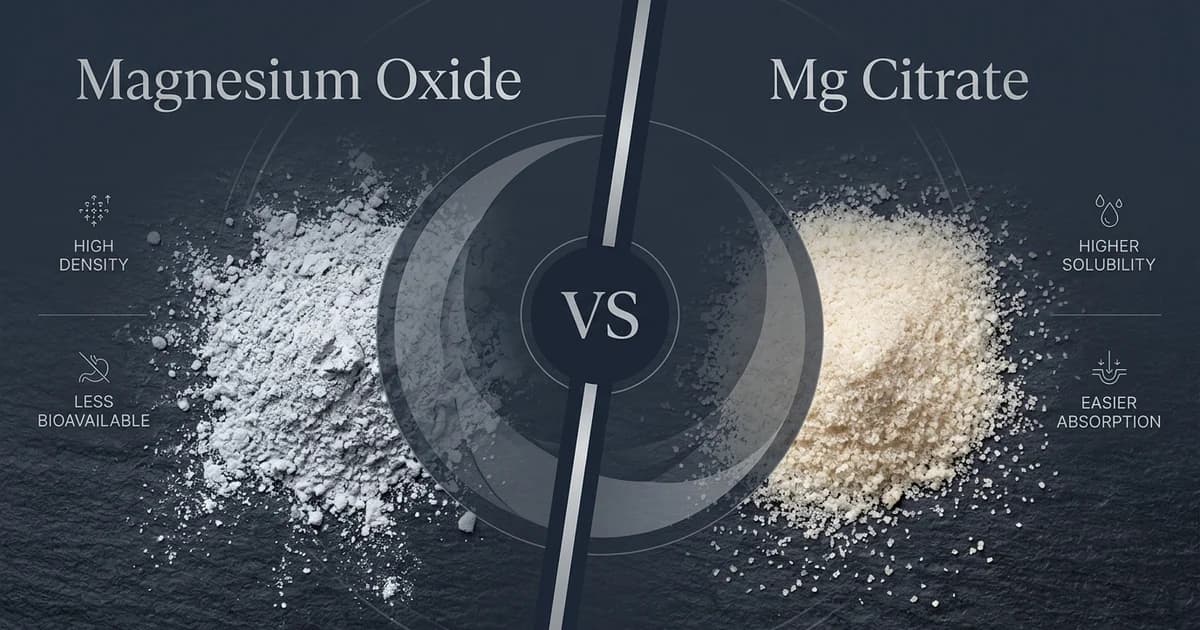
A study indexed on PubMed from the University of Texas Southwestern Medical Center found that magnesium citrate was "more soluble and bioavailable than magnesium oxide." The urinary magnesium excretion (a reliable marker of absorption) was roughly four times higher with citrate than with oxide.
Some sources estimate magnesium oxide's actual absorption rate at less than 4%. So from a 400mg magnesium oxide capsule containing 240mg of elemental magnesium, your body might absorb fewer than 10mg. The rest? It stays in your digestive tract, which explains magnesium oxide's other well-known use.
The Laxative Problem
Magnesium oxide is commonly used as a laxative and antacid. According to MedlinePlus, it's approved for short-term, rapid emptying of the bowel. Healthline notes that "its strong laxative effects are why it's commonly used to treat constipation."
If you're taking magnesium oxide for sleep, you might get more bathroom trips than restful nights. That's not exactly the outcome you're looking for when evaluating magnesium oxide vs citrate for sleep.
There's also a timing problem. Most people take magnesium before bed. If your chosen form triggers GI distress, you're now dealing with disrupted sleep for a completely different reason. The irony isn't lost on anyone who's tried it.
Magnesium Citrate: Better Absorbed, Better Studied for Sleep
Magnesium citrate pairs magnesium with citric acid, creating a salt that dissolves more readily in the gut. It contains about 11% elemental magnesium by weight, which is less than oxide per capsule. But the absorption story flips the math entirely.
A randomized crossover study published in BMC Nutrition confirmed that urinary magnesium excretion was statistically higher after citrate supplementation compared to oxide. A separate study on PubMed reinforced this, concluding that "MgC shows higher bioavailability compared with MgO."
In plain terms: you take less elemental magnesium with citrate, but more of it actually gets where it needs to go. This is why magnesium citrate vs oxide for sleep isn't even a close contest on the absorption front.
Citrate and Sleep: The Practical Case
Because magnesium citrate delivers more usable magnesium to the bloodstream, it's more likely to reach the threshold needed to influence GABA and NMDA receptor activity in the brain. This makes citrate the stronger candidate in the magnesium oxide vs citrate for sleep comparison.
Citrate can still cause loose stools at high doses (it's sometimes used as a bowel prep before medical procedures), but at typical supplemental doses of 200-400mg, most people tolerate it well. For sleep purposes specifically, that tolerability matters.
Magnesium Oxide vs Citrate for Sleep: The Full Comparison
| Factor | Magnesium Oxide | Magnesium Citrate |
|---|---|---|
| Elemental Mg per dose | ~60% by weight | ~11% by weight |
| Bioavailability | Very low (estimated <4%) | Moderate to high (~60%) |
| Sleep support potential | Limited due to poor absorption | Stronger due to better absorption |
| GI side effects | High (strong laxative effect) | Mild at normal doses |
| Cost | Very cheap | Slightly more expensive |
| Best use case | Constipation relief, antacid | General supplementation, sleep support |
The bottom line on magnesium citrate vs oxide for sleep is straightforward: citrate wins on absorption, tolerability, and practical effectiveness. Oxide wins on price and elemental magnesium content per pill, but those advantages evaporate if the mineral never reaches your brain. Anyone seriously researching magnesium oxide vs citrate for sleep should weigh absorption over label claims.
What About Other Forms of Magnesium for Sleep?
Citrate isn't the only well-absorbed option. Magnesium glycinate (bonded to the amino acid glycine) is popular for sleep because glycine itself has calming properties, and magnesium glycinate for sensitive stomachs is explored in detail alongside gluconate in a separate comparison. It's generally the gentlest on the stomach, making it a solid choice for people sensitive to citrate's mild laxative effect.
Magnesium L-threonate is the newer contender, and the full glycinate vs L-threonate for sleep breakdown covers how these two forms stack up in detail. A study covered by AJMC found that magnesium L-threonate improved both objective and subjective sleep quality in a placebo-controlled trial. L-threonate is one of the few forms shown to cross the blood-brain barrier efficiently, which makes it particularly interesting for cognitive and sleep applications. The downside: it's the most expensive option by a wide margin.
Each form has trade-offs in cost, dosing, and side effects. But if your choice is specifically magnesium oxide vs citrate for sleep, citrate is the better pick.
Quick Form Comparison
| Form | Absorption | GI Tolerance | Sleep Relevance | Price |
|---|---|---|---|---|
| Oxide | Very low | Poor | Weak | $ |
| Citrate | Good | Moderate | Strong | $$ |
| Glycinate | Good | Excellent | Strong | $$ |
| L-Threonate | Excellent (crosses BBB) | Good | Very strong | $$$ |
How to Take Magnesium Citrate for Sleep
If you've settled the magnesium oxide vs citrate for sleep question and decided citrate is the right form (and for most people comparing these two, it is), here are a few practical tips:
- Dose: 200-400mg of magnesium citrate taken 30-60 minutes before bed. Start at the lower end to assess your GI tolerance.
- Timing: Consistency matters more than perfection. Take it at roughly the same time each evening.
- With food or without: Magnesium citrate absorbs well either way, but taking it with a small snack can reduce any stomach discomfort.
- Give it time: Magnesium builds up in your system over days and weeks. Don't expect dramatic results on night one.
One thing to keep in mind: if you're already getting adequate magnesium from your diet (leafy greens, nuts, seeds, dark chocolate), supplementation may produce a smaller effect. The biggest improvements tend to show up in people who are deficient, which is another reason the magnesium citrate vs oxide for sleep distinction matters so much. You want every milligram you take to count.
The Bigger Picture: Sleep Isn't Just About One Mineral
Understanding magnesium oxide vs citrate for sleep is one piece of the puzzle. Good sleep depends on a stack of factors: consistent circadian cues, low evening cortisol, adequate GABA activity, and how melatonin compared to magnesium fits into what you actually take at night.
That's the same principle behind well-designed nootropic stacks. Instead of relying on a single ingredient, you combine compounds that work on complementary pathways. L-Theanine, for example, promotes alpha brain wave activity and supports GABA production through a different mechanism than magnesium. Theacrine and methylliberine modulate adenosine signaling without the tolerance buildup you get from caffeine alone.
This is the thinking behind Roon, a zero-nicotine sublingual pouch built on a stack of Caffeine (80mg), L-Theanine, Theacrine, and Methylliberine. It's designed for sustained daytime focus (6-8 hours, no jitters, no crash) rather than sleep. But the principle is the same: the right combination of compounds, properly dosed, outperforms any single ingredient.
If you're optimizing your magnesium oxide vs citrate for sleep choice for better nights, it's worth thinking about what you're using for better days, too. See how Roon compares.