L-Theanine Benefits for ADHD: What Science Actually Shows
Roon Team
L-Theanine Benefits for ADHD: What Science Actually Shows
Most articles about L-theanine and ADHD fall into one of two camps. The first treats it like a miracle supplement that replaces medication. The second dismisses it entirely. Both are wrong. The actual research on l-theanine benefits for ADHD is more specific, more interesting, and more useful than either extreme suggests.
Here's what we know so far about l-theanine benefits for ADHD, what we don't, and what the data actually means for your brain.
Key Takeaways
- L-theanine modulates several neurotransmitters tied to attention and impulse control, including GABA, dopamine, and serotonin.
- Clinical trials in boys with ADHD show measurable improvements in sleep quality and cognition scores, though sample sizes remain small.
- The L-theanine and caffeine combination has the strongest evidence for improving sustained attention, including in ADHD populations.
- L-theanine is not a replacement for ADHD medication. Among l-theanine benefits for ADHD, the strongest are supporting focus through a different mechanism than stimulant drugs.
What L-Theanine Actually Does in the Brain
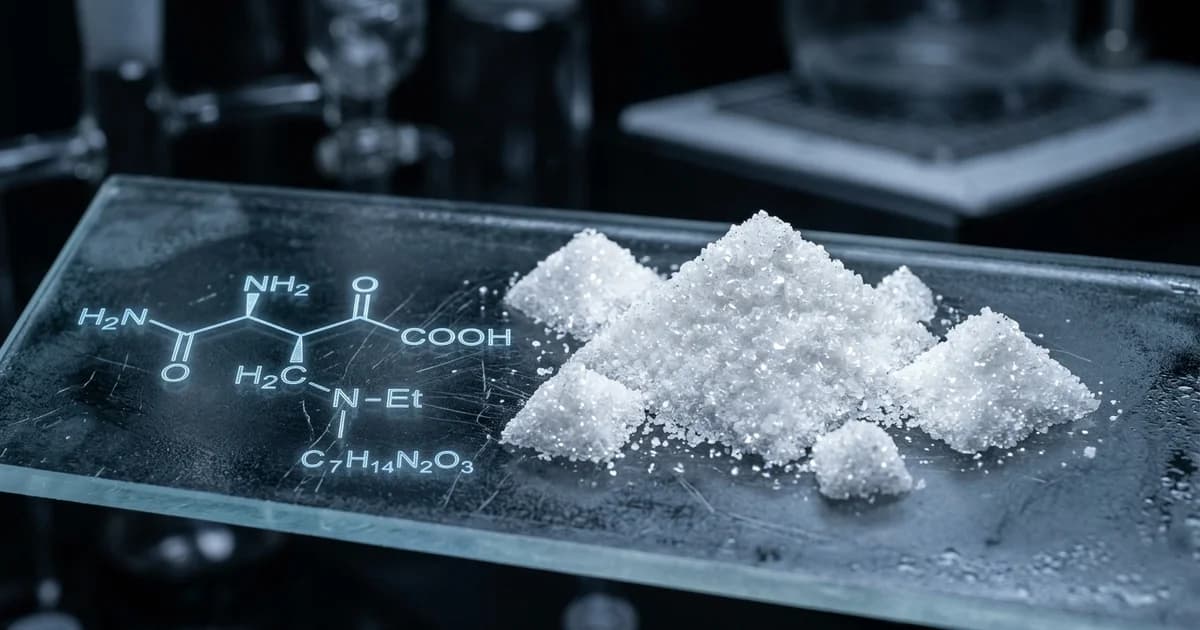
L-theanine (technically N-ethyl-L-glutamine) is an amino acid found almost exclusively in tea leaves. It crosses the blood-brain barrier within about 30 minutes of ingestion, which is fast for a dietary compound.
Once it arrives, it gets to work on multiple neurotransmitter systems. Animal neurochemistry studies show that L-theanine increases brain levels of serotonin, dopamine, and GABA, and has measurable affinity for AMPA, kainate, and NMDA glutamate receptors. That's a broad neurochemical profile for a single amino acid, and it helps explain why l-theanine benefits for ADHD span multiple symptom domains.
The GABA and dopamine effects matter most for the ADHD conversation. GABA is the brain's primary inhibitory neurotransmitter, the one that helps you not do something (like check your phone mid-sentence). Dopamine drives motivation and reward processing. Both systems are dysregulated in ADHD, which is why l-theanine benefits for ADHD are tied directly to these pathways.
L-theanine also increases alpha wave activity in the brain. Alpha waves are associated with a state of relaxed alertness, the kind of calm focus you get during meditation or deep flow states. This is the opposite of the jittery, scattered activation pattern you see with stimulants alone.
The ADHD-Specific Clinical Evidence
Let's look at the actual trials. There aren't dozens of them, but the ones that exist are well-designed and directly relevant to l-theanine benefits for ADHD.
The Sleep Study (2011)
Sleep disruption is one of the most common and least-discussed problems in ADHD. A randomized, double-blind, placebo-controlled trial studied 98 boys aged 8 to 12, all formally diagnosed with ADHD. Half received 400mg of L-theanine daily (split into two doses), and half received placebo, for six weeks.
The results were clear. Boys taking L-theanine showed higher sleep percentage and sleep efficiency scores measured by actigraphy (a wrist-worn device that objectively tracks sleep). There was also a trend toward less nighttime wakefulness. Sleep latency and total sleep time didn't change, but the quality of sleep improved.
Why does this matter? Because poor sleep makes every ADHD symptom worse. Inattention, impulsivity, emotional dysregulation: all of them amplify when sleep quality drops. Among l-theanine benefits for ADHD, improved sleep efficiency without sedation is a meaningful and often overlooked tool.
The Cognition and Attention Study (2020)
A proof-of-concept neuroimaging RCT published in Scientific Reports examined the acute effects of L-theanine, caffeine, and their combination in boys with ADHD. This was a randomized, four-way crossover design, meaning each participant served as his own control across all conditions: L-theanine alone (2.5 mg/kg), caffeine alone (2.0 mg/kg), the combination, and placebo.
The findings: L-theanine alone improved total cognition composite scores on the NIH Cognition Toolbox compared to placebo (p = 0.040). The L-theanine and caffeine combination improved performance on sustained attention tasks and reduced task-related brain reactivity on fMRI. These results offer some of the most direct evidence for l-theanine benefits for ADHD at the neural level.
The sample was small (five boys), which limits how broadly you can apply the results. But the crossover design and neuroimaging data give the findings more weight than the sample size alone would suggest. Each participant was tested under all four conditions, which controls for individual variability.
The 2025 Systematic Review
A 2025 systematic review published on PMC searched PubMed/MEDLINE and Scopus databases through February 2025 for studies on supplements and ADHD symptoms. The review found that L-theanine and caffeine, among other supplements, showed various positive effects on ADHD symptoms across randomized controlled trials and open-label studies.
This isn't a ringing endorsement, and it shouldn't be. The evidence base is still growing. But the direction is consistent: l-theanine benefits for ADHD show up across the specific cognitive domains that the condition disrupts most.
Why the L-Theanine and Caffeine Combination Keeps Showing Up
If you've read any research on l-theanine benefits for ADHD, you've noticed a pattern. L-theanine works well alone, but it works better with caffeine.
A study of 44 young adults found that 97mg of L-theanine combined with 40mg of caffeine improved focus during demanding cognitive tasks compared to placebo. That specific dose combination, roughly a 2:1 ratio of L-theanine to caffeine, keeps appearing across the literature.
The logic behind the pairing is straightforward. Caffeine increases alertness and reaction speed but can also increase anxiety and jitteriness. L-theanine promotes calm focus through GABA modulation and alpha wave enhancement. Together, you get the alertness without the edge.
A 2025 double-blind crossover trial tested a high-dose L-theanine and caffeine combination (200mg L-theanine with caffeine) in sleep-deprived young adults. The combination improved hit rate and target-distractor discriminability on attention tasks, with corresponding changes in brain event-related potentials measured by EEG.
For people with ADHD, this matters because the core deficit isn't a lack of stimulation. It's a failure of selective attention: the ability to focus on what matters and filter out what doesn't. The L-theanine and caffeine combination targets exactly that process, which is why this pairing is central to any discussion of l-theanine benefits for ADHD.
L-Theanine Benefits for ADHD: What They Can and Can't Do
Let's be precise about the boundaries.
What the evidence supports:
- Improved sleep quality in children with ADHD (400mg/day, six-week trial)
- Improved cognition composite scores (acute dosing, small sample)
- Enhanced sustained attention when combined with caffeine
- Increased alpha wave activity associated with calm focus
- A favorable safety profile with no serious adverse effects reported in trials
What the evidence does not support:
- Replacing prescribed ADHD medication
- Treating ADHD as a standalone intervention
- Eliminating hyperactivity or impulsivity symptoms
- Any claim about "curing" attention deficits
L-theanine is a well-researched amino acid that modulates neurotransmitter systems relevant to attention and impulse control. It is not a pharmaceutical, and the research, while promising, involves relatively small sample sizes. Larger trials are needed before l-theanine benefits for ADHD can be stated with full clinical confidence.
That said, the mechanistic data is strong. L-theanine does what it claims to do at the neurochemical level. The clinical question is how much that translates into real-world symptom improvement, and for whom.
Building a Smarter Stack
The research on l-theanine benefits for ADHD points in a clear direction: L-theanine works best as part of a system, not in isolation. Its effects on GABA, dopamine, and alpha wave activity create a foundation of calm focus. Caffeine adds alertness and processing speed. The combination targets selective attention more effectively than either compound alone.