Healthy Replacement for Coffee: What Actually Works
Roon Team
Healthy Replacement for Coffee: What Actually Works (and What's Just Marketing)
Sixty-six percent of American adults drink coffee every day. That number is at a 20-year high, and it keeps climbing. But a growing share of those same drinkers are quietly looking for a healthy replacement for coffee, not because they hate the taste, but because the side effects have started to outweigh the benefits. The jitters. The 2 p.m. crash. The creeping anxiety that shows up thirty minutes after your second cup.
You don't need to quit caffeine. You need to rethink how you consume it.
This article breaks down the most common coffee alternatives on the market, what the research actually says about each one, and how to find a healthy replacement for coffee that gives you the focus you want without the neurochemical chaos that comes with 200+ mg of caffeine dumped into your bloodstream before 9 a.m.
Key Takeaways:
- Most popular coffee alternatives either remove caffeine entirely (missing the point) or just repackage it in a different form.
- The real problem with coffee isn't caffeine itself. It's the dose, the delivery speed, and the absence of calming co-factors.
- A low-dose caffeine paired with L-theanine consistently outperforms high-dose caffeine alone in cognitive performance studies.
- The best healthy replacement for coffee keeps what works (alertness, motivation) and removes what doesn't (jitters, crashes, tolerance buildup).
Why People Are Looking for a Healthy Replacement for Coffee
Coffee is not the villain. Let's get that out of the way first. It's loaded with antioxidants, it improves short-term focus, and decades of epidemiological data link moderate consumption to lower risks of several diseases.
The problem is what happens when moderate turns into habitual.
A standard drip coffee delivers roughly 95 mg of caffeine per cup. Most people don't stop at one. By mid-morning, you're sitting at 200 to 300 mg, and your body is responding accordingly. Caffeine blocks adenosine receptors in the brain, which is the mechanism behind that initial alertness. But it also activates the hypothalamic-pituitary-adrenal (HPA) axis, increasing cortisol and adrenaline, your core stress hormones.
That's fine in small, controlled doses. It's less fine when you're stacking cups to fight the tolerance you've built over months or years. This is exactly why the search for a healthy replacement for coffee has become so common.
Research published in Frontiers in Psychology examined the relationship between caffeine intake and anxiety risk across multiple studies. The pattern is consistent: higher habitual caffeine intake correlates with increased anxiety symptoms, especially in people already prone to stress.
So the question isn't really "should I quit coffee?" It's "is there a smarter, healthier way to get the same cognitive benefits?"
The Most Common Coffee Alternatives (Ranked by Usefulness)
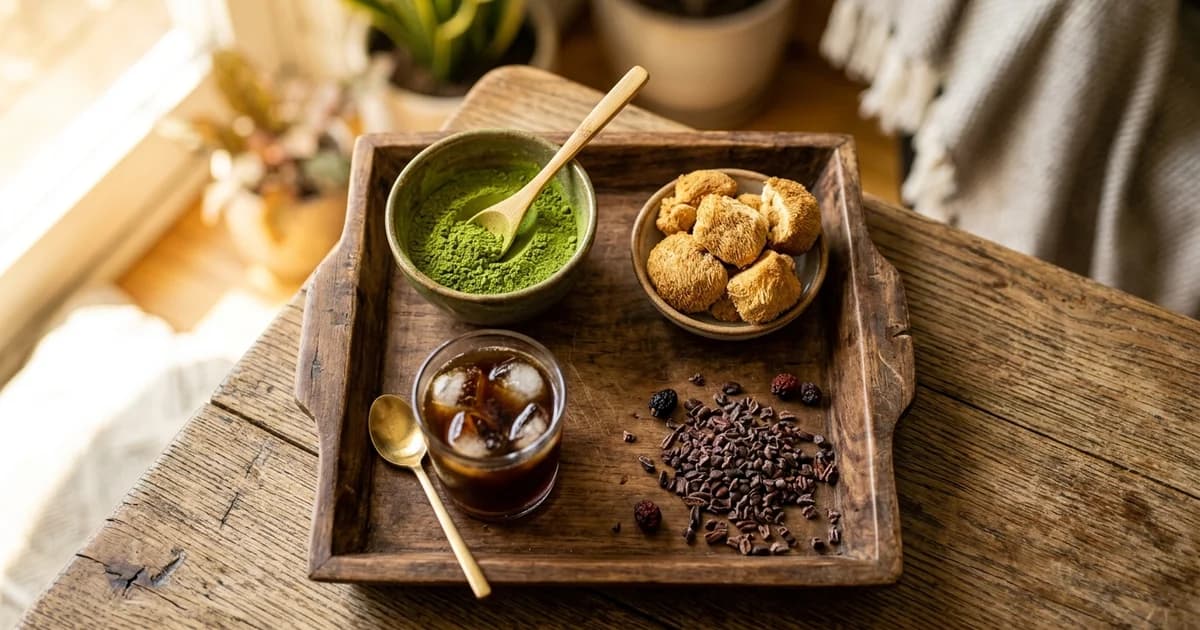
Walk into any health food store and you'll find a dozen coffee alternatives beyond matcha claiming to be a healthy replacement for coffee. Most of them fall into a few predictable categories. Here's what the science says about each one.
Matcha
Matcha is the closest thing to a direct coffee upgrade. A typical serving contains 25 to 70 mg of caffeine (depending on preparation) plus a natural dose of L-theanine, an amino acid that promotes alpha brain wave activity, the neural signature of calm, focused attention.
The caffeine-to-L-theanine ratio in matcha is what makes it a compelling healthy replacement for coffee. You get alertness without the spike-and-crash pattern. Research on matcha's stress-reducing properties found that continuous matcha intake improved work performance and attention under psychological stress compared to caffeine alone.
The catch: Quality varies wildly. Cheap matcha is basically green tea dust with minimal L-theanine content. Ceremonial-grade matcha is expensive, often $30 to $50 for a small tin. And the preparation ritual, while pleasant, isn't exactly convenient at your desk.
Verdict: Solid option if you're willing to pay for quality and don't mind the prep.
Mushroom Coffee
Among the best mushroom coffee brands, MUD\WTR and Ryze have built entire businesses on the idea of blending functional mushrooms (lion's mane, chaga, reishi, cordyceps) with a small amount of caffeine. The pitch: cognitive benefits from the mushrooms, mild energy from the caffeine, none of the downsides of a full cup of coffee.
The reality is more nuanced. Lion's mane does have some evidence supporting nerve growth factor stimulation, but most human studies use concentrated extracts at doses higher than what you'd get in a blended coffee product. You're drinking a fraction of a clinically studied dose mixed into a warm beverage.
The catch: The caffeine content is usually low (around 35 to 50 mg), which is actually a good thing. But the mushroom doses are often too low to deliver the effects the marketing promises. As a healthy replacement for coffee, mushroom blends are a step in the right direction but rarely the full solution.
Verdict: Better than a third cup of coffee. Probably not as effective as the branding suggests.
Chicory Coffee
Chicory root has been used as a coffee substitute since at least the Civil War. It's caffeine-free, tastes vaguely like coffee (with a nuttier, slightly woody profile), and contains inulin, a prebiotic fiber that supports gut health.
According to Cleveland Clinic, chicory's inulin content can aid digestive health and feed beneficial gut bacteria. It also contains antioxidant enzymes that help reduce inflammation.
The catch: Zero caffeine means zero cognitive boost. If you're looking for a healthy replacement for coffee that still helps you focus and perform, chicory isn't going to deliver. It's a taste replacement, not a functional one. It can also cause bloating and gas in some people, and it's not recommended during pregnancy.
Verdict: Fine if your only goal is to stop drinking coffee. Not useful if you actually need to think clearly at work.
Green Tea
A standard cup of green tea delivers about 30 to 50 mg of caffeine with a modest amount of L-theanine. It's a gentler stimulant than coffee, and the polyphenol content (especially EGCG) has well-documented antioxidant properties.
The catch: The L-theanine content in regular green tea is lower than in matcha, and the caffeine dose is often too mild for people accustomed to coffee. You might need three or four cups to feel meaningfully alert, which defeats the purpose of finding a healthy replacement for coffee.
Verdict: A good daily health habit. A mediocre coffee replacement for anyone who needs real focus.
Yerba Mate
Yerba mate contains roughly 85 mg of caffeine per cup, plus theobromine and small amounts of theophylline. The stimulant profile is broader than coffee's, which some people find produces a smoother energy curve.
The catch: The caffeine content is almost as high as coffee, so you're not solving the dose problem. And the taste is polarizing, to put it gently.
Verdict: A lateral move, not an upgrade.
The Real Problem: Dose and Delivery
Here's what most "healthy replacement for coffee" articles miss entirely.
The issue with coffee isn't the molecule. Caffeine, at the right dose, is one of the most well-studied and effective cognitive enhancers on the planet. The issue is that coffee delivers too much of it, too fast, with nothing to smooth out the neurochemical edges.
A study published on PubMed tested a combination of 97 mg L-theanine and 40 mg caffeine against a placebo in 44 young adults. The combination improved cognitive performance and increased subjective alertness within 20 minutes, without the anxiety or cardiovascular stress associated with higher caffeine doses.
That's less than half the caffeine in a single cup of coffee. And it worked better for sustained attention. This is why any truly effective healthy replacement for coffee needs to address dose and delivery, not just swap one beverage for another.
A separate study on PubMed found that combining L-theanine with caffeine improved both speed and accuracy on attention-switching tasks and reduced susceptibility to distracting information during memory tasks. The effects held at both 60 and 90 minutes post-ingestion.
The pattern across the research is clear: low-dose caffeine combined with L-theanine consistently outperforms high-dose caffeine alone on measures of focus, attention, and working memory.
What About Tolerance?
One of coffee's biggest hidden costs is tolerance. Your brain adapts to daily caffeine by upregulating adenosine receptors. Within a few weeks of consistent use, you need more caffeine just to feel normal. That's not enhanced performance. That's dependency maintenance. A true healthy replacement for coffee should break this cycle, not perpetuate it.
This is where compounds like theacrine and methylliberine become relevant. Both are purine alkaloids structurally related to caffeine, but they interact with adenosine receptors differently.
A randomized crossover study published in Cureus tested a combination of caffeine, theacrine (TeaCrine), and methylliberine (Dynamine) in 50 young adults. The combination improved cognitive performance and reaction time without negatively affecting mood. A related trial in tactical personnel found that co-ingestion of caffeine, methylliberine, and theacrine may sustain cognitive performance over a longer period compared to caffeine alone.
The practical takeaway: stacking caffeine with theacrine and methylliberine appears to extend the duration of cognitive benefits while reducing the tolerance-building cycle that makes coffee less effective over time. That combination is what separates a real healthy replacement for coffee from a simple ingredient swap.
A Comparison of Coffee Alternatives
| Alternative | Caffeine (mg) | L-Theanine | Cognitive Benefit | Crash Risk | Convenience |
|---|---|---|---|---|---|
| Drip Coffee | 95-200 | None | High (short-term) | High | High |
| Matcha | 25-70 | Moderate | Moderate-High | Low | Low-Medium |
| Green Tea | 30-50 | Low | Low-Moderate | Low | High |
| Mushroom Coffee | 35-50 | None | Low-Moderate | Low | Medium |
| Chicory Coffee | 0 | None | None | None | High |
| Yerba Mate | 85 | None | Moderate | Moderate | Medium |
| Caffeine + L-Theanine Stack | 40-100 | High | High | Low | Varies |
The pattern is obvious. The alternatives that actually work as a healthy replacement for coffee share two features: a controlled caffeine dose and the presence of L-theanine or similar calming co-factors.
What a Smarter Healthy Replacement for Coffee Looks Like
If you're designing the ideal healthy replacement for coffee from scratch, the formula writes itself based on the research:
- Low-dose caffeine (40 to 100 mg) for alertness without overstimulation.
- L-theanine to promote alpha wave activity and smooth out caffeine's excitatory effects.
- Theacrine and methylliberine to extend the duration of focus and reduce tolerance buildup.
- Fast, controlled delivery so the active compounds reach your system predictably, not dependent on how much water you drank or whether you ate breakfast.
That's not a hypothetical stack. That's the exact formulation behind Roon, a sublingual pouch that delivers 80 mg of caffeine alongside L-theanine, theacrine, and methylliberine directly through the oral mucosa. No brewing. No crash. No building tolerance week after week. It's the healthy replacement for coffee that the research actually supports.
If your current coffee habit is giving you more anxiety than focus, the fix isn't quitting caffeine. It's fixing the delivery system.
Clean energy, zero crash. Try Roon.