Coffee Machine Replacement Parts: What to Fix, What to Skip
Roon Team
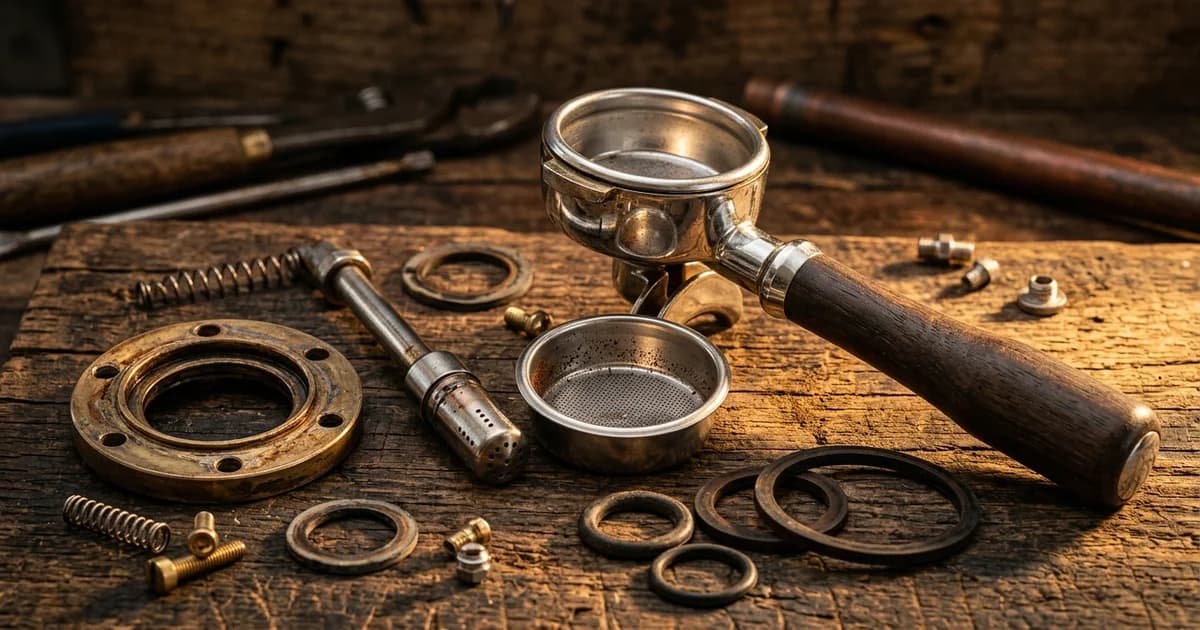
Coffee Machine Replacement Parts: What to Fix, What to Skip, and When to Walk Away
Your espresso machine made a noise this morning it's never made before. Or maybe the shots have been pulling thin and sour for a week. Either way, you're staring down the barrel of a repair, and you need to figure out which coffee machine replacement parts to order, what they cost, and whether the fix is even worth it.
Coffee machine replacement parts can be a confusing world. OEM vs. aftermarket, gaskets vs. seals, vibratory pumps vs. rotary vane. This guide cuts through the noise. We'll cover the parts that actually fail, what they cost, when you can fix them yourself, and when you should just move on.
Key Takeaways:
- Most coffee machine failures come down to five categories of parts: gaskets/seals, pumps, brew groups, water filters, and heating elements.
- Sourcing coffee machine replacement parts yourself for DIY repairs can save you 60-80% over professional service for many common fixes.
- Entry-level machines (under $150) are almost never worth repairing.
- Preventive maintenance, especially descaling and gasket replacement, extends machine life by years.
The Five Coffee Machine Replacement Parts That Actually Break
Not every component in your coffee machine is equally likely to fail. After sifting through repair guides, technician forums, and brand-specific data, the same five categories of coffee machine replacement parts come up over and over.
1. Group Head Gaskets and Seals
This is the single most common replacement part in espresso machines. The group head gasket creates the seal between the portafilter and the brew group. When it wears out, water leaks around the basket instead of pushing through the coffee. You'll see dripping, hear hissing, or notice your shots running weak.
According to Specialty Coffee ID, group head seals should be replaced annually on espresso machines, while general gaskets and seals need swapping every 6 to 12 months depending on use. A complete annual maintenance kit (gaskets, shower screen, backflush disc) typically runs $15 to $30 for popular semi-automatic models like the Gaggia Classic or Rancilio Silvia. These are among the most affordable coffee machine replacement parts you'll buy.
Signs you need a new gasket: water leaking from the portafilter junction, the handle feeling loose when locked in, or visible cracking on the rubber when you remove it.
2. Water Pumps
The pump is the heart of any espresso machine. It generates the 9 bars of pressure (roughly 130 PSI) needed to force water through finely ground coffee. Home machines almost universally use vibratory pumps, while commercial setups run rotary vane pumps.
Vibratory pumps are smaller and cheaper but have a finite lifespan. According to Clive Coffee, they typically last 5 to 6 years. Rotary pumps last longer but cost more to replace. When your pump starts to fail, you'll notice weak pressure, loud buzzing, or the machine struggling to push water through the group head. Of all the coffee machine replacement parts you might need, a new pump is one of the more involved swaps.
Pump replacement costs vary. For a DeLonghi super-automatic, expect $100 to $175 for professional replacement. DIY? The pump itself often costs $25 to $50 for a vibratory unit, and YouTube has step-by-step teardown videos for most popular models.
3. Brew Groups
The brew group is where extraction happens. In super-automatic machines, this is a mechanical assembly that compresses coffee, brews it, and ejects the puck. It's a complex moving part, and it wears down.
Here's where machine design matters enormously. Coffee In Touch reports that machines with removable brew groups (DeLonghi, Philips/Saeco, Gaggia super-automatics) are designed for owner maintenance. You pull the brew group out, rinse it, lubricate the rails, and put it back. Machines with sealed, non-removable brew groups (Jura, Miele) require professional service that can run $300 to $850 per visit, making coffee machine replacement parts for those brands far more expensive overall.
If you're shopping for a super-automatic, this single design choice determines your long-term repair costs more than almost any other feature.
4. Water Filters and Descaling Components
Scale is the silent killer of coffee machines. Mineral deposits from hard water build up inside boilers, thermoblocks, and water lines. Left unchecked, scale restricts flow, reduces heating efficiency, and eventually causes component failure that sends you hunting for coffee machine replacement parts.
Specialty Coffee ID recommends replacing water filters every 2 to 3 months. This is the cheapest form of preventive maintenance you can do, and it directly extends the life of your pump, boiler, and heating elements. A replacement filter costs $8 to $20 depending on your machine.
Descaling should happen monthly for heavy users or quarterly for moderate ones. If you've never descaled your machine and you've owned it for more than six months, do it now. The $8 bottle of descaling solution is infinitely cheaper than the boiler replacement you're heading toward.
5. Heating Elements and Thermoblocks
When your machine stops producing hot water or steam entirely, the heating element is usually the culprit. Thermoblocks (used in most home machines) heat water on demand. Boilers (used in higher-end and commercial machines) maintain a reservoir of heated water.
Thermoblock coffee machine replacement parts tend to be more involved repairs, often running $80 to $200 for parts plus labor. For single-boiler home machines, this repair is usually worth it if the machine cost more than $300 originally. For cheaper machines, the math rarely works out.
Coffee Machine Replacement Parts: A Cost Comparison
Here's a quick reference for what common coffee machine replacement parts cost, both DIY and professional:
| Part | DIY Cost (Parts Only) | Professional Repair Cost | Replacement Frequency |
|---|---|---|---|
| Group head gasket | $3–$8 | $30–$60 | Every 6–12 months |
| Shower screen | $5–$15 | $30–$50 | Every 12 months |
| Water filter | $8–$20 | N/A (user-replaceable) | Every 2–3 months |
| Vibratory pump | $25–$50 | $100–$175 | Every 5–6 years |
| Brew group (removable) | $40–$80 | $150–$300 | Every 3–5 years |
| Thermoblock/boiler element | $50–$120 | $150–$350 | Varies |
| Control board/electronics | $60–$200 | $200–$500+ | Varies |
Prices based on common home espresso machines. Commercial equipment costs considerably more.
When to Repair vs. When to Replace
Not every machine deserves a second life. Before ordering coffee machine replacement parts, here's how to think about it.
Repair if:
- The machine originally cost more than $300.
- The repair costs less than 40% of the replacement price.
- Only one thing is broken. A single failed component is normal wear.
- The machine has a strong parts ecosystem (Gaggia, Rancilio, E61-based machines, DeLonghi).
Replace if:
- The machine cost under $150 new. Espresso Repair Experts notes that entry-level machines often last only a few years, and repair costs frequently approach or exceed replacement cost.
- Multiple parts are failing at once. This usually signals the machine has entered its wear-out phase.
- The brand has no established repair ecosystem or third-party coffee machine replacement parts supply.
- You're on your second or third major repair in 12 months.
Where to Find Coffee Machine Replacement Parts
Sourcing the right part matters as much as knowing which part you need, whether you're exploring Keurig replacement parts options or tracking down components for an espresso machine.
OEM (Original Equipment Manufacturer) Parts
These come directly from the machine's brand. They're guaranteed to fit and function correctly, but they cost more. For warranty purposes, OEM coffee machine replacement parts are usually the safe choice.
Aftermarket and Universal Parts
Many espresso machine components are standardized. E61 group heads, for example, use a design standard dating back to 1961, and coffee machine replacement parts for them are universally available from dozens of suppliers. Gaskets, shower screens, and portafilter baskets are often interchangeable across brands that share the same group head design.
Specialty Retailers
Dedicated espresso parts retailers like Espresso Parts, Chris' Coffee, and Seattle Coffee Gear carry both common and hard-to-find components. These shops also tend to have knowledgeable support staff who can help you identify the exact coffee machine replacement parts you need.
The DIY Community
For popular machines like the Gaggia Classic, Rancilio Silvia, or any E61-based espresso maker, online communities have documented virtually every repair. Reddit's r/espresso and r/coffeemakers, along with brand-specific forums, are goldmines for teardown guides and part numbers.
Maintenance That Prevents the Need for Coffee Machine Replacement Parts
The cheapest replacement part is the one you never need to buy. A basic maintenance routine keeps most machines running for a decade or more.
Daily: Wipe down the steam wand after every use. Purge it with a quick burst of steam to clear milk residue. Rinse the drip tray.
Weekly: Remove and wash the portafilter basket, referring to a filter basket replacement guide if yours shows wear, along with the shower screen and any removable brew components. Pro Coffee Gear recommends backflushing the group head regularly to remove coffee oils that build up behind the shower screen.
Monthly: Descale with a citric acid solution or manufacturer-recommended descaler. Check gaskets for visible wear.
Quarterly: Replace the water filter. Lubricate the brew group rails on super-automatic machines.
Annually: Replace the group head gasket and shower screen. For commercial or high-use home machines, consider a professional service that includes pressure calibration and a full internal inspection.
The Hidden Cost of Coffee Machine Replacement Parts
Here's a number most coffee enthusiasts don't think about. According to SimplyCodes, the 5-year maintenance and repair cost for a mid-range espresso machine runs $400 to $500, while higher-end super-automatics can hit $1,000 to $1,500 over the same period. That's on top of the $100 to $1,000 you spent on the machine itself. A big chunk of that spending goes toward coffee machine replacement parts and the labor to install them.
Add in the beans, filters, and descaling solution, and you're looking at a real investment. For some people, that investment is absolutely worth it. Great espresso at home is a genuine pleasure, and maintaining your machine is part of the craft.
But for others, especially those who just want reliable caffeine without the maintenance overhead, there's a simpler path.
Clean Energy Without the Maintenance
If what you actually need is consistent, focused energy, and you're tired of troubleshooting machines, chasing coffee machine replacement parts, and scrubbing group heads, it's worth reconsidering the delivery system entirely.
Roon is a zero-nicotine sublingual pouch built around 80 mg of caffeine paired with L-Theanine, Theacrine, and Methylliberine. It delivers 6 to 8 hours of sustained focus without the jitters, the crash, or the $15 shower screen replacement you forgot to order. No machine. No maintenance. No parts to source.
Clean energy, zero crash. Just the focus you came for.