Most Focus Supplements Are Marketing Hype
Roon Team
Most Focus Supplements Are Marketing Hype: The 4 Ingredients With Real Clinical Backing
The best focus supplement isn't the one with the longest ingredient list. It's the one where every ingredient has a reason to be there, backed by randomized controlled trials in actual humans, at doses that match what the research tested.
Most nootropics fail this test. The typical "brain blend" stacks six to ten ingredients under a proprietary label, hides the doses, and leans on rodent studies or centuries-old traditional use claims. You get a capsule full of marketing copy and 50 mg of something that needs 300 mg to work. Then you feel nothing, assume nootropics are all hype, and go back to your fourth espresso.
That skepticism is earned. But the science of cognitive performance isn't empty. There are focus supplements that actually work, backed by replicated human trial data for acute attention and mental energy. This article walks through what doesn't work, what does, and why the distinction matters.
Key Takeaways:
- Most popular nootropic ingredients (lion's mane, bacopa, ginkgo, racetams) either lack human evidence, require months to show effects, or sit in a legal gray zone.
- Four compounds have strong RCT data for acute cognitive performance: caffeine, L-theanine, theacrine (TeaCrine), and methylliberine (Dynamine).
- The combination of these four outperforms any single ingredient, with published trials showing improvements in reaction time, sustained attention, and speed-accuracy tradeoffs.
- Roon is built around all four at pharmacologically relevant doses, with no proprietary blends hiding the numbers.
The Proprietary Blend Problem
The supplement industry has a transparency issue, and nootropics sit right at its center. A report from SupplySide Journal documented how proprietary blends in the nootropics category routinely obscure individual ingredient amounts, making it impossible for consumers to evaluate whether doses match clinical evidence.
Take Onnit's Alpha Brain, one of the best-selling nootropics in the U.S. Reviewers at Innerbody noted that many of its ingredients are listed as part of proprietary blends that obscure how much of each compound is actually in a serving. Fortune's 2026 review echoed the same concern: the proprietary blend format means consumers don't know the actual amount of each ingredient.
This isn't a minor labeling preference. If a study tested bacopa at 300 mg and your supplement contains 40 mg buried in a 660 mg "brain blend," you're not taking the studied dose. You're taking a fraction of it, paying full price, and wondering why nothing happened.
5 Popular Nootropic Ingredients That Don't Earn Their Hype
Before getting to what works, it's worth understanding whether focus supplements actually work and why so many leave users feeling nothing. If you're searching for the best supplement for focus, knowing what fails is just as important as knowing what succeeds.
Lion's Mane Mushroom
Lion's mane produces compounds (hericenones and erinacines) that promote nerve growth factor synthesis in preclinical models. The problem: a 2024 review from the Oncology Nursing Society concluded that clinical data on lion's mane remains limited, with much of the evidence coming from animal and cell studies. A 2025 narrative review in PMC acknowledged that clinical research on H. erinaceus remains limited, with many studies relying on animal models. The few human trials that exist used long supplementation windows (12-16 weeks) and small sample sizes. This is a compound that might do something over months. It's not an acute focus tool.
Bacopa Monnieri
Bacopa has more human data than lion's mane, but the timeline kills it as a daily focus supplement. A randomized, double-blind trial published in PMC tested 300 mg of B. monnieri daily and found that cognitive improvements appeared after 12 weeks, not days or hours. A separate 12-week PMC trial confirmed the same pattern: effects on working memory and attention emerged only after sustained daily use. Bacopa may have a role in long-term supplementation protocols, but marketing it as something you take before a work session is misleading.
Ginkgo Biloba
Ginkgo has been sold as a memory supplement for decades. The clinical data tells a different story. A meta-analysis published in PubMed examined whether G. biloba enhances cognitive function in healthy individuals and reported that it had no ascertainable positive effects on a range of targeted cognitive functions. A 2025 review in ScienceDirect found that ginkgo extract had small and clinically meaningless effects on cognition, behavior, and functional ability. If you're healthy and looking for a focus edge, ginkgo isn't it.
Racetams (Piracetam, Aniracetam, etc.)
Racetams occupy a strange regulatory space. According to PMC research, piracetam belongs to the racetam family of drugs, of which only levetiracetam (a seizure medication) has been approved by the FDA for use in the U.S. They cannot be legally marketed as dietary supplements. Following DOJ enforcement actions in 2023-2024, reputable vendors stopped carrying racetams entirely. Beyond legality, the cognitive evidence in healthy adults is inconsistent, and you can't verify purity or dose from unregulated sources.
Curcumin / Turmeric
Curcumin has well-documented anti-inflammatory properties, but its bioavailability is notoriously poor without specialized delivery systems, and the cognitive evidence in healthy adults is thin. It's an anti-inflammatory compound being marketed as a focus supplement. Different mechanism, different use case.
| Ingredient | Human RCT Evidence for Acute Focus | Onset Time | Regulatory Status |
|---|---|---|---|
| Lion's Mane | Limited; mostly animal data | 12-16 weeks (if any) | Legal supplement |
| Bacopa Monnieri | Moderate; long-term only | 8-12 weeks | Legal supplement |
| Ginkgo Biloba | Meta-analyses show no effect in healthy adults | N/A | Legal supplement |
| Racetams | Inconsistent | Acute, but variable | Not FDA-approved as supplement |
| Curcumin | Minimal for cognition | Unclear | Legal supplement |
| Caffeine | Strong; 90+ years of data | 15-45 minutes | GRAS |
| L-Theanine | Strong; EEG-confirmed | 30-60 minutes | GRAS |
| Theacrine | Strong; RCTs show no tolerance | 30-60 minutes | Legal supplement (NDI) |
| Methylliberine | Growing; combination RCTs | 15-30 minutes | Legal supplement (NDI) |
The 4 Clinically Backed Nootropics That Earn the Label
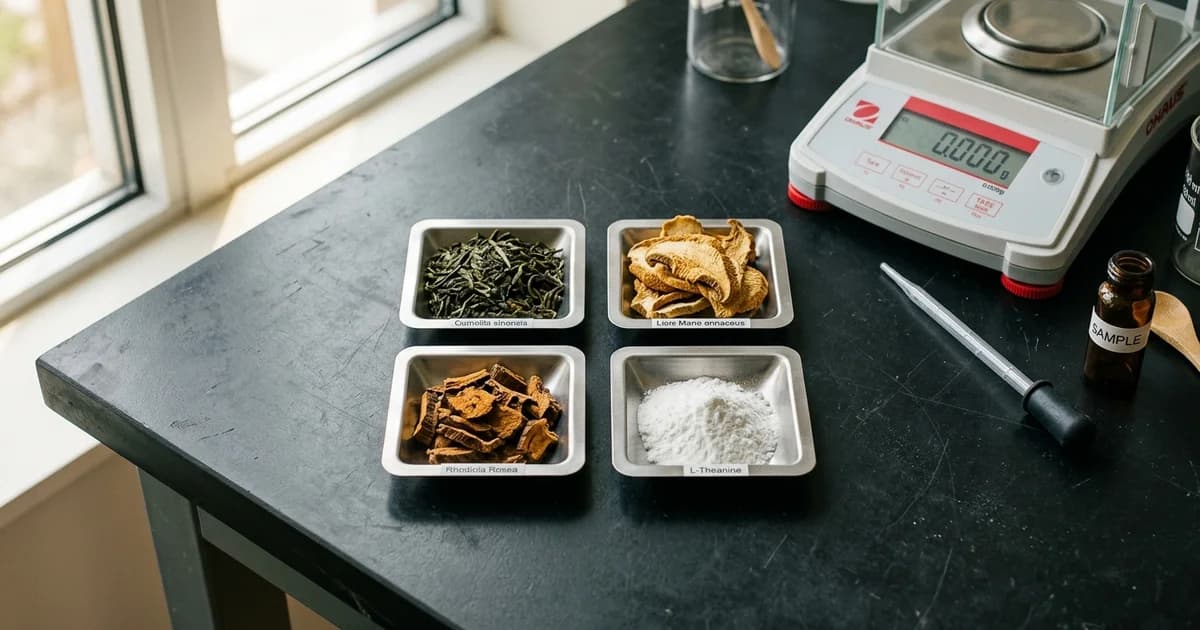
Here's where the evidence-based focus supplement research gets interesting. When you strip away the marketing and look at nootropic clinical evidence, four compounds consistently show up. Four compounds have replicated human trial data showing acute improvements in attention, reaction time, or cognitive processing. And they work even better together.
1. Caffeine
This isn't new or exciting, and that's the point. Caffeine is the most studied psychoactive compound on the planet. A 2025 systematic review and meta-analysis in Psychopharmacology analyzed the acute effect of caffeine on attention across dozens of studies and concluded that caffeine acutely enhances attention by improving both reaction time and accuracy in the normal population.
The evidence base spans over 90 years. Caffeine blocks adenosine receptors, reducing the signal that makes you feel tired, while increasing dopamine and norepinephrine activity. The effective dose range for cognitive performance is 40-300 mg, with diminishing returns and increased side effects (jitters, anxiety, disrupted sleep) at higher doses.
The problem with caffeine alone: tolerance builds within days of consistent use, the crash is real, and high doses trade focus for anxiety. Caffeine is the foundation, but it needs partners.
2. L-Theanine
L-theanine is an amino acid found naturally in tea leaves, and it does something unusual: it promotes relaxation without sedation. A 2008 study published in The Journal of Nutrition demonstrated that L-theanine and caffeine in combination affect human cognition, with measurable changes in oscillatory alpha-band brain activity during attention tasks. Alpha-band activity (8-14 Hz) is associated with relaxed alertness, the mental state where you can sustain focus without tension.
The caffeine-theanine combination is one of the most replicated findings in nootropic research. Caffeine provides the drive; L-theanine smooths the edges. You get alertness without the jittery overshoot. This is why tea feels different from coffee despite both containing caffeine. The ratio matters, and clinical doses typically range from 50-200 mg of L-theanine paired with a moderate caffeine dose.
3. Theacrine (TeaCrine)
Theacrine is a purine alkaloid structurally related to caffeine, found naturally in Camellia kucha tea. It acts on the same adenosine and dopamine pathways as caffeine but with a critical difference: it doesn't build tolerance the same way.
An 8-week clinical trial published in PMC tested TeaCrine at low and high doses in 60 healthy men and found no evidence of a tachyphylactic or habituation response, the kind of tolerance that is typical of caffeine and other stimulants. The same study confirmed clinical safety across all measured biomarkers.
This matters because caffeine tolerance is the reason your morning coffee stops working after two weeks at the same dose. Theacrine provides a similar lift through overlapping pathways without triggering the same receptor downregulation. For anyone looking for clinically backed nootropics that sustain their effect over weeks and months, theacrine is one of the few compounds with published data to support that claim.
4. Methylliberine (Dynamine)
Methylliberine is the newest member of this purine alkaloid family, with a faster onset and shorter duration than theacrine. It acts on adenosine receptors and inhibits phosphodiesterase, providing a quick boost in energy and alertness.
The strongest evidence for methylliberine comes from combination studies. A 2021 randomized crossover trial published in Cureus (Tartar et al.) tested caffeine alone versus caffeine combined with Dynamine and TeaCrine in 50 male egamers and found that the combination increased cognitive performance and reaction time without interfering with mood. A follow-up 2023 study (Evans et al.) confirmed that the caffeine-TeaCrine-Dynamine combination improved neurophysiological measures of cognitive activity and helped resolve the speed-accuracy tradeoff where caffeine alone makes you faster but less precise.
A standalone methylliberine study found that 100 mg improved multiple indices of affect (mood, motivation, energy) in healthy adults, though cognitive measures in isolation were less clear. The takeaway: methylliberine's primary value is as a combination player, amplifying and smoothing the effects of caffeine and theacrine.
Why the Combination Matters More Than Any Single Ingredient
The research on these four compounds points to a consistent pattern: the stack outperforms any individual component.
Caffeine alone improves reaction time but increases errors at higher doses. L-theanine alone promotes alpha-wave activity but doesn't drive alertness. Theacrine alone provides a non-habituating lift but has a slower onset. Methylliberine alone boosts mood and energy but shows limited standalone cognitive effects.
Combine them, and you get something different. The Tartar (2021) and Evans (2023) trials both used the caffeine-theacrine-methylliberine combination and found improvements across reaction time, sustained attention, and the speed-accuracy tradeoff that caffeine alone can't solve. L-theanine adds the alpha-wave modulation that keeps the combination smooth rather than jagged.
This is what separates a pharmacologically coherent formula from a marketing-driven ingredient list. Each compound addresses a specific limitation of the others. That's not a "proprietary blend" pitch. It's dose-response pharmacology.
Related from Roon
- 50 Esports Pros, 3 Compounds, Zero Anxiety: Inside the Clinical Trial That Proves the Modern Nootropic Stack Beats Caffeine Alone
- Beyond the 6-Hour Window: How Multi-Compound Nootropic Stacks Engineer All-Day Cognitive Endurance
- Studying vs. Lifting vs. Boardroom: How to Match Your Nootropic Stack to the Cognitive Task
The Best Focus Supplement Is the One That Shows Its Work
If you've tried nootropics before and felt nothing, you probably weren't taking the right ingredients at the right doses. And you had no way to know, because the label didn't tell you.
Roon was built to fix that problem. Every pouch contains 80 mg caffeine, 60 mg L-theanine, 25 mg methylliberine (Dynamine), and 5 mg theacrine (TeaCrine), printed on the label with no proprietary blends. These are the four compounds with replicated human trial data for acute cognitive performance, delivered sublingually for faster absorption than capsules or drinks.
The formula is designed for sustained, clean focus without the jitter-crash cycle of high-caffeine products and without the tolerance buildup that makes stimulants less effective over time. Roon's own cognitive testing data showed improvements in response speed and sustained attention across their tested formulations.
This isn't another supplement asking you to trust a proprietary blend. It's four ingredients, four doses, and the published research to back each one. See the full formula and reasoning at takeroon.com.