HOW MUCH CAFFEINE IS IN MATCHA VS COFFEE? THE FULL BREAKDOWN
Roon Team
How Much Caffeine Is in Matcha vs Coffee? The Full Breakdown
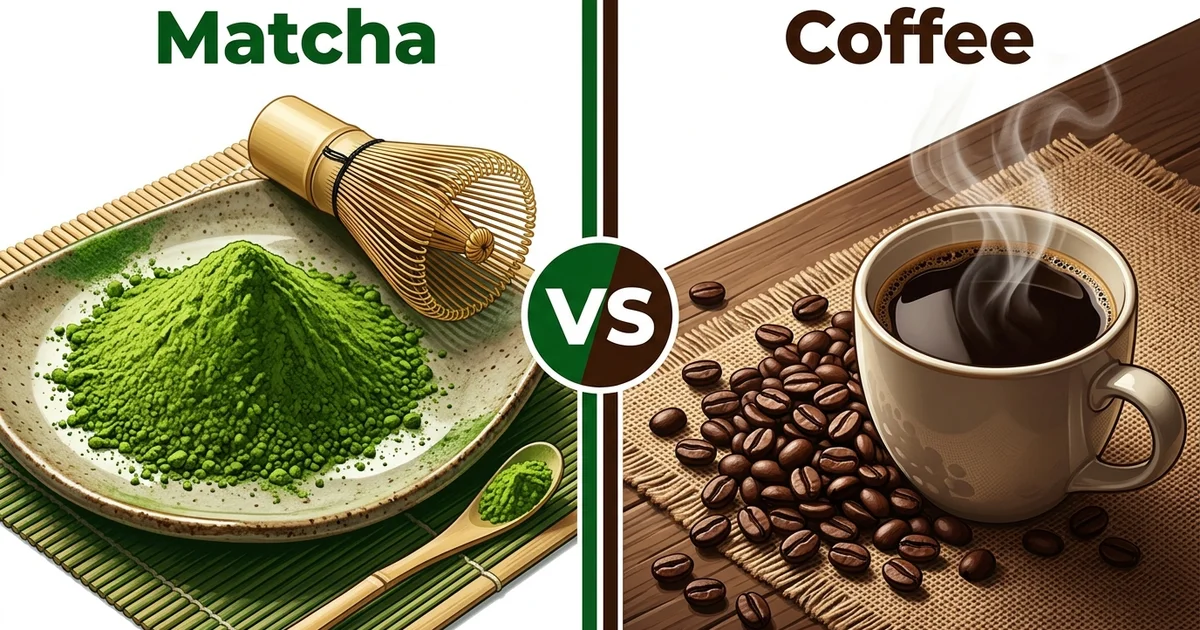
You just ordered a matcha latte because someone told you it's "healthier than coffee." But how much caffeine is in matcha vs coffee, really? And does the difference actually matter for how you feel at 2 p.m.?
The short answer: coffee has roughly twice the caffeine per cup. The longer answer involves absorption speed, amino acids, and why milligrams alone don't tell the whole story.
Key Takeaways
- A standard cup of coffee contains 95 to 200 mg of caffeine. A cup of matcha lands between 38 and 80 mg.
- Matcha delivers caffeine alongside L-theanine, an amino acid that smooths out the energy curve and reduces jitteriness.
- Coffee hits harder and faster, but that spike often comes with a crash 2 to 3 hours later.
- Neither is objectively "better." Understanding how much caffeine is in matcha vs coffee helps you choose the right energy source for your needs and schedule.
How Much Caffeine Is in Matcha vs Coffee by the Numbers
Let's start with the raw data. The caffeine in coffee vs matcha varies depending on preparation, but here's what a typical serving looks like:
| Drink | Serving Size | Caffeine (mg) |
|---|---|---|
| Drip coffee | 8 oz | 95–200 |
| Espresso (single shot) | 1 oz | ~63 |
| Cold brew | 12 oz | ~207 |
| Matcha (standard) | 8 oz (2g powder) | 38–80 |
| Matcha (strong/ceremonial) | 8 oz (4g powder) | 80–175 |
According to Healthline, an 8-ounce cup of brewed coffee contains between 95 and 200 mg of caffeine, with the average landing around 150 mg based on a 2020 study. Healthline's matcha breakdown puts matcha at 19 to 44 mg of caffeine per gram of powder, with a typical 2-gram serving yielding 38 to 88 mg.
So on a per-cup basis, the caffeine content matcha vs coffee isn't even close. Coffee wins by a wide margin. But knowing how much caffeine is in matcha vs coffee is only half the equation.
Why Matcha Caffeine Feels Different Than Coffee Caffeine
You've probably heard someone say matcha gives them "calm energy." That's not marketing fluff. It's biochemistry, and it's the reason the caffeine in coffee vs matcha produces such different experiences.
Matcha contains L-theanine, an amino acid that crosses the blood-brain barrier and promotes alpha brain wave activity. Alpha waves are associated with a state of relaxed alertness, the kind you experience during focused work without the tight-chest feeling that a double espresso can produce.
A typical cup of matcha delivers roughly 20 to 40 mg of L-theanine per serving. Coffee contains almost none.
A study published in Nutritional Neuroscience tested a combination of 97 mg L-theanine and 40 mg caffeine against a placebo in 44 young adults. The combination improved cognitive performance and increased subjective alertness more effectively than caffeine or placebo alone. The L-theanine didn't cancel out the caffeine. It refined it.
This is why asking how much caffeine is in matcha vs coffee misses the point if you only look at milligrams. Matcha's caffeine is absorbed more gradually because you're consuming the entire ground tea leaf, not a brewed extract. That slower release, paired with L-theanine, creates a longer, flatter energy curve instead of the sharp spike-and-crash pattern most coffee drinkers know too well.
The Coffee Crash Problem
Coffee's energy profile looks like a roller coaster. Caffeine blocks adenosine receptors in your brain, which is why you feel awake. But adenosine doesn't stop building up just because the receptors are blocked. When the caffeine wears off (typically 2 to 3 hours after that initial spike), all that accumulated adenosine floods your receptors at once.
That's the crash. And it's why your 9 a.m. coffee often leaves you reaching for another cup by noon. The caffeine content in matcha vs coffee helps explain why matcha drinkers rarely report the same mid-morning wall.
The Mayo Clinic notes that caffeine's effects vary based on individual metabolism, tolerance, and even genetics. But the pattern is consistent: a fast onset followed by a relatively fast decline.
Matcha's energy curve is different. Because L-theanine modulates how caffeine affects neurotransmitter activity, the energy tends to sustain for 4 to 6 hours without the same pronounced drop-off. You're getting less caffeine, but you're getting more usable hours out of it. That's the real answer to how much caffeine is in matcha vs coffee: less per cup, but more per hour of productive work.
Coffee vs Matcha: Which One Is Actually Better for Focus?
This depends on what "focus" means to you, and understanding the caffeine content matcha vs coffee can help you decide.
If you need a fast, intense burst of alertness, coffee is hard to beat. A strong cup of drip coffee or a double espresso delivers 150 to 300 mg of caffeine in minutes. For short, high-intensity tasks, that hit can be exactly what you need.
If you need sustained concentration over several hours, matcha has a structural advantage. The L-theanine and caffeine combination supports attention without the anxiety or restlessness that higher caffeine doses can trigger. A 2025 double-blind, placebo-controlled crossover study confirmed that an L-theanine and caffeine combination improved selective attention in sleep-deprived young adults, reinforcing earlier findings on the pair's cognitive benefits.
For most knowledge workers, writers, coders, and students, the second scenario is more relevant. You don't need to feel wired for 45 minutes. You need to stay locked in for four hours. That context reframes how much caffeine is in matcha vs coffee from a simple numbers question into a performance question.
The Tolerance Factor
Here's something most caffeine comparisons skip: tolerance. Regular coffee drinkers build a tolerance to caffeine within 1 to 2 weeks of consistent use. That means the same cup that used to feel electric eventually just gets you to baseline.
Matcha drinkers experience this too, though the lower per-serving dose means the tolerance curve is less aggressive. Comparing caffeine in coffee vs matcha, the tolerance difference is real but often overlooked. Both drinks share the same fundamental limitation: caffeine tolerance erodes the benefit over time.
The Caffeine Content in Matcha vs Coffee: A Summary Table
| Factor | Coffee | Matcha |
|---|---|---|
| Caffeine per 8 oz cup | 95–200 mg | 38–80 mg |
| L-theanine per serving | ~0 mg | 20–40 mg |
| Onset speed | Fast (15–20 min) | Gradual (30–45 min) |
| Duration of effect | 2–3 hours | 4–6 hours |
| Crash likelihood | High | Low |
| Tolerance buildup | Fast | Moderate |
| Antioxidant content (ORAC) | 200–550 units/g | ~1,384 units/g |
The antioxidant comparison is worth noting. Japan Heartful Store's analysis reports matcha's ORAC (Oxygen Radical Absorbance Capacity) value at roughly 1,384 units per gram, compared to coffee's 200 to 550 units per gram. This doesn't directly affect your energy levels, but it does speak to matcha's broader nutritional profile. Once you've settled how much caffeine is in matcha vs coffee, antioxidant density becomes the next useful comparison.
What If You Want the Best of Both (Without the Downsides of Either)?
Both matcha and coffee share a core limitation: they rely on caffeine as their primary active compound. Caffeine works. But it works best when it's supported by other compounds that extend its duration, reduce its side effects, and prevent tolerance from dulling the effect. The caffeine content matcha vs coffee debate often ends here, because neither drink fully solves the tolerance problem.
That's the thinking behind nootropic stacks, formulations that combine caffeine with complementary ingredients instead of just piling on more milligrams.
Roon takes this approach. It's a zero-nicotine sublingual pouch that pairs 40 mg of caffeine (roughly the same as a cup of matcha) with L-theanine, theacrine, and methylliberine. A study on this combination of caffeine, theacrine, and methylliberine found it improved cognitive performance and reaction time without increasing anxiety or headaches. And because theacrine doesn't produce the same tolerance buildup as caffeine alone, the effect stays consistent over time.
No brewing. No crash. No ritual required. Just 4 to 6 hours of clean focus, delivered sublingually in about 5 minutes.
If you're tired of debating how much caffeine is in matcha vs coffee and want something that combines the best of both, see how Roon compares.
READY TO UNLOCK YOUR FOCUS?
Subscribe for exclusive discounts and more content like this delivered to your inbox.