How to Actually Focus Working From Home When Everything Is a Distraction
Roon Team
How to Actually Focus Working From Home When Everything Is a Distraction
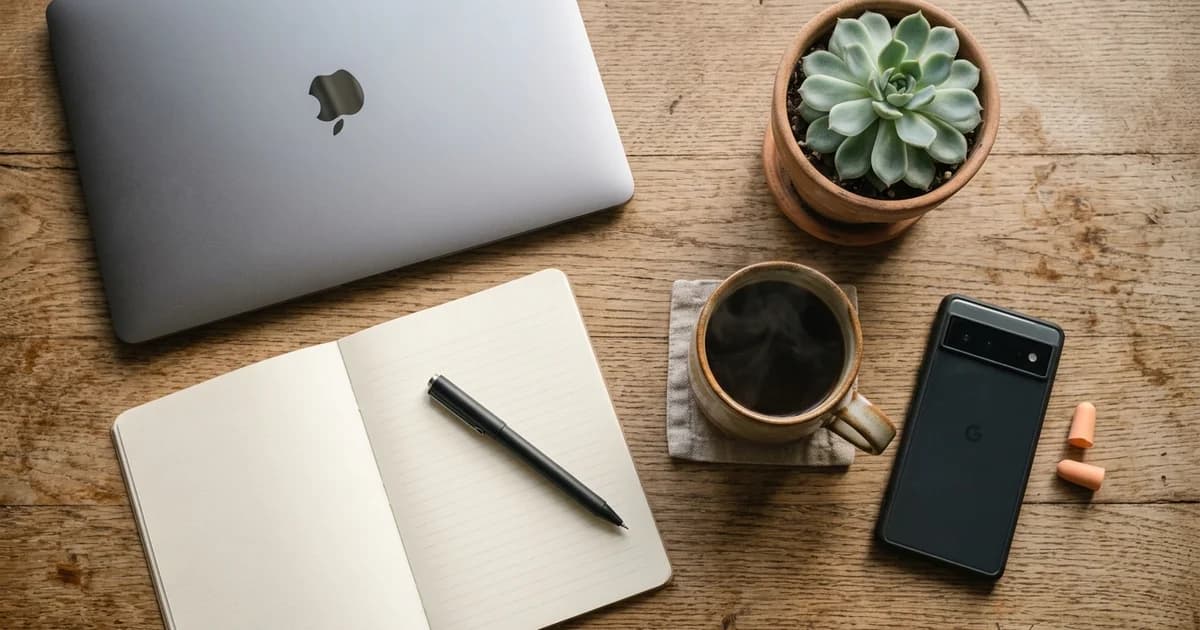
Your laptop is open. Your coffee is hot. You have exactly one task that matters today. Then the dryer buzzes, your phone lights up, and a roommate asks if you've seen the good scissors. Forty minutes later you're still not started.
Learning how to stay focused working from home is less about willpower and more about engineering. The office did a lot of quiet work for you: the social pressure, the dedicated desk, the absence of a sink full of dishes in your eyeline. At home, those guardrails vanish, and your brain has to build them itself.
The good news is that focus at home is a solvable problem. You just have to attack the right variables.
Key Takeaways
- A single interruption costs you about 23 minutes. Cutting the number of interruptions matters more than working "harder."
- Most home distractions are environmental, not personal. Fix the room and the schedule before you blame yourself.
- Batch your shallow work. Email and Slack are not focus; they are the enemy of it.
- Your energy curve is a tool. Match your hardest work to your sharpest hours, and protect that window.
Why Working From Home Wrecks Your Focus
The core problem is that remote work removes friction from distraction and adds friction to deep work. At home, the fridge is ten steps away and your manager is not.
The data backs this up. A survey by SellCell found that 80% of employees who work from home unintentionally lose work hours to distractions and demands that wouldn't arise if they were at the office. Hubstaff's research on remote work points to the same culprits. Around 80% of remote workers get distracted by kids, partners, pets, and other things that are not an issue in an office setting.
Then there is the recovery cost, which is the part most people miss. Gloria Mark's research at UC Irvine established that after a single interruption, it takes an average of 23 minutes and 15 seconds to fully return to the original task, and people don't jump directly back to what they were doing, since there are typically two intervening tasks before the original work is resumed.
Do the math. If you get interrupted just five times a day, that's nearly two hours of lost productivity. You are not lazy. You are getting taxed 23 minutes at a time, all day long.
How to Stay Focused Working From Home: The 6 Rules That Actually Work
The fix is not a single trick. It is a stack of small structural changes that each remove a category of distraction. Here is the order that works.
1. Build a Hard Start, Not Just a Hard Stop
Most remote workers obsess over when to log off. The bigger lever is a ritual that tells your brain work has begun.
Pick a trigger you repeat every morning: a specific playlist, making your coffee in the same mug, or a five-minute walk around the block that simulates a commute. The point is consistency. When the cue is identical every day, your brain stops negotiating about whether to start.
2. Make the Distraction Harder Than the Work
You will not out-discipline a phone that sits face-up on your desk. So change the physics.
Put your phone in another room, not in your pocket. Log out of personal accounts on your work browser. If household chores pull you in, close the door so the dishes leave your line of sight. You are not trying to resist temptation all day. You are trying to make temptation inconvenient enough that resisting it is automatic.
3. Batch Shallow Work Into Windows
Email and Slack feel like work, but they are mostly interruption wearing a productivity costume. Answering a message the second it arrives trains everyone, including you, to expect instant replies.
Check messages at set times: maybe 11 a.m., 2 p.m., and 4:30 p.m. Outside those windows, close the tabs. This single habit removes the largest source of self-inflicted interruptions and protects the 23-minute recovery cost from happening dozens of times a day.
4. Match Hard Work to Your Sharpest Hours
You have a daily energy curve, and most people fight it. They spend their best two morning hours clearing the inbox, then try to write the strategy doc at 3 p.m. when their brain is fog.
Flip it. Guard your peak window, usually the first two to three hours after you start, for the one task that needs real thinking. Save the shallow stuff for the dip. If you are struggling to focus working from home in the afternoon, that is biology, not failure, and the schedule should bend around it.
5. Use Time Blocks With Visible Edges
Open-ended workdays bleed. A task with no deadline expands to fill the entire day and still doesn't get finished.
Work in defined blocks of 50 to 90 minutes on a single task, then take a real break away from the screen. The visible edge creates urgency, and the break prevents the slow decay of attention that makes the last hour of work nearly useless.
6. Manage Your Inputs, Including Caffeine
How to be productive working from home is partly a chemistry question. The standard remote routine is three coffees before noon and a crash at 2 p.m. that no amount of discipline can override.
The crash is the problem. A large dose of caffeine alone spikes alertness and then drops it, often with jitters in between. The research on pairing caffeine with the amino acid L-theanine is more interesting. A study found that the combination of L-theanine and caffeine improves cognitive performance and increases subjective alertness. The theanine smooths the edges off the caffeine, which is why the two are so often used together.
How to Focus When Working From Home: A Quick Comparison of Tools
When people ask how to focus working from home, they usually reach for one of a few categories of tools. Each solves a different piece of the puzzle. Here is an honest breakdown.
| Tool | What It Fixes | Onset | Downside |
|---|---|---|---|
| Website blockers (Freedom, Cold Turkey) | Digital interruptions | Instant | Easy to disable; doesn't touch household distractions |
| Noise-canceling headphones | Ambient noise, family interruptions | Instant | Can cause ear fatigue; signals "leave me alone" inconsistently |
| Black coffee | Baseline alertness | 30-45 min | Jitters and an afternoon crash; tolerance builds |
| L-theanine + caffeine combo | Calm, sustained alertness | 30-45 min | Pills are slow; dosing varies widely |
| Roon sublingual pouch | Fast, sustained focus | 5-10 min | Not a fix for poor sleep or a chaotic environment |
No single row solves everything. Blockers handle your screen, headphones handle your room, and the chemistry options handle your alertness. The strongest setup usually combines one from each category.
How to Stop Struggling to Focus Working From Home in the Afternoon
The afternoon slump is the single most common complaint among remote workers, and it has a clear cause. Your morning caffeine has worn off, your blood sugar dipped after lunch, and your natural circadian rhythm dips around 2 to 3 p.m.
Fighting it with more coffee usually backfires by wrecking your sleep that night, which makes tomorrow worse. A better approach is a short walk in real daylight, a glass of water, and a smaller, smarter dose of stimulant rather than a fourth cup. The goal is a gentle lift, not another spike.
Conclusion
Focus at home is an engineering problem, not a character flaw. Every interruption you remove saves you roughly 23 minutes of recovery, which means the move with the biggest payoff is simply having fewer of them.
Build a hard start to your day. Make distractions physically inconvenient. Batch your shallow work, protect your sharpest hours, and stop treating caffeine as a single blunt instrument. None of these require heroic willpower. They require a setup that does the discipline for you, so the focused hours happen by default instead of by force.
Frequently Asked Questions
Why is it so much harder to focus at home than in the office?
The office quietly enforced focus through social pressure, a dedicated desk, and the absence of household distractions. At home, those guardrails disappear. Roughly 80% of remote workers get distracted by kids, partners, pets, and things that are not an issue in an office setting. You also have instant access to your fridge, your couch, and your phone, so the friction that used to protect your attention is gone.
How long does it really take to refocus after a distraction?
Longer than most people think. Research from UC Irvine found that after a single interruption, it takes an average of 23 minutes and 15 seconds to fully return to the original task. That is why minimizing the number of interruptions matters more than trying to work faster. A handful of interruptions can quietly erase a couple of productive hours.
What is the fastest way to stop getting distracted by my phone?
Physical distance beats willpower. Put your phone in another room rather than in your pocket or on your desk. The few seconds it takes to walk and retrieve it is usually enough to break the automatic reach. Pair this with turning off non-essential notifications, so the phone stops actively pulling your attention even when it is out of sight.
Does caffeine actually help me focus, or does it just wake me up?
Both, but with a catch. A large dose of caffeine alone tends to spike alertness and then crash it, often with jitters. A study found that the combination of L-theanine and caffeine improves cognitive performance and increases subjective alertness. The theanine takes the edge off, which produces calmer, steadier focus than caffeine by itself.
How do I beat the 2 p.m. afternoon slump?
The slump comes from worn-off caffeine, a post-lunch blood sugar dip, and your natural circadian rhythm. Instead of a fourth coffee that wrecks your sleep, take a short walk in daylight, drink water, and use a smaller, smarter dose of stimulant. The aim is a gentle lift rather than another spike and crash.
How many breaks should I take when working from home?
Work in focused blocks of 50 to 90 minutes, then take a genuine break away from the screen. The visible edge of a time block creates useful urgency, and the break prevents the slow decay of attention that makes your last work hour nearly useless. Stepping outside or stretching is far better than scrolling, which just trades one screen for another.
The 23-Minute Tax, Solved With Chemistry That Holds
Everything above comes back to one number: the roughly 23 minutes you lose every time your attention breaks. The afternoon crash is one of the worst offenders, because it doesn't just interrupt you, it drains you for the rest of the day.
That is the gap Roon is built for. It's a zero-nicotine sublingual pouch with a four-ingredient formula: 80 mg caffeine, 60 mg L-theanine, 25 mg methylliberine (Dynamine), and 5 mg theacrine (TeaCrine). Because it absorbs sublingually, it kicks in within 5 to 10 minutes and is designed to hold 6 to 8 hours of steady focus with no jitters, no crash, and no tolerance buildup. It's discreet enough to use at your desk without a coffee run.
Roon will not fix a chaotic room, poor sleep, or a phone you leave face-up on your desk. Build the environment first. Then, if you want a cleaner alternative to your third coffee, try Roon for the hours that actually matter.
Written by Roon Team